Find trusted data
Find the data behind a business question and see why it can be trusted.
Explore the approachYou review the sources, destination and effects.

Inspect diagram labels
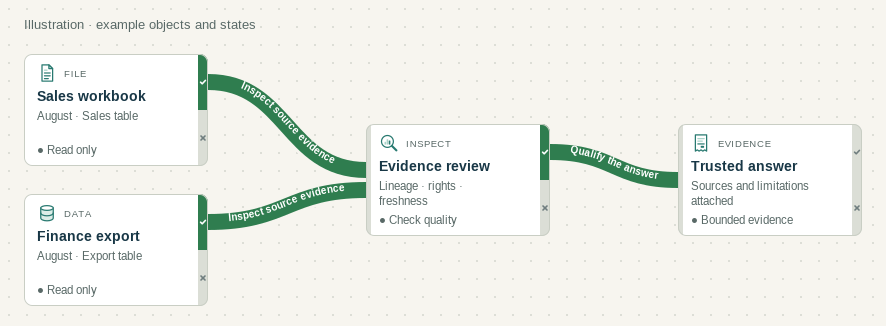
Start with the question.
Keep the explanation.
The Agent helps shape the plan. The configured objects and evidence remain yours to inspect and use directly.
- Your sources
- Reviewed work
- Your result
An approach to review, not a record of completed work.
Start from the business question
Begin with the business question and choose the Workspace source that should hold the answer. Storage detail comes later.
Prepare your review
Continuing from this guide opens your Workspace's Connect data page, where you connect a source or open one you already have. Nothing is read until you test or capture it. The Find trusted data starter template stays on Home: starting it creates only a folder, inert Canvas draft, and Solution Brief, and does not contact a provider, create a Connection, inspect rows, move data, or establish trust.
Discover sources I can connect
Template version 2 lists governed Connections visible with your current Workspace rights. Mail, cloud and local labels are suggestions, not discovered accounts or files. An Editor can select one readable table-scoped SQL Server Connection and a business question. Selection makes no provider call. Explicit Capture reads bounded rows into a retained Dataset Revision and Representation, attaches Objective evidence to the Canvas, and reopens the exact result from Recent work. A changed or revoked Connection blocks another capture. Classification pending and Objective Unknown still need review before a trust claim.
Choose one source
Open the approach, choose one readable File or source, then confirm 'Preserve and verify'. Edit is required; otherwise show honest unavailability. A listing or declared connector is not observed access.
Inspect what you own
The exact source becomes a Dataset Revision and Representation. An Objective Manifest and Objective Receipt can be reopened, while source custody remains its own; the guide and Agent receive references, not rows.
Read the evidence
Independently check lineage, rights, freshness, and quality, then reread the Receipt. Unavailable evidence stays unavailable, and an unobserved lifecycle remains unproven.
Recover without guessing
Upload a missing File, ask an Owner for rights, refresh stale or incomplete evidence, and retain the connector's one-source and one-mode limit.
Find trusted data
The trusted answer remains attached to its source evidence and visible limitations.
Continue this Journey
Prepare this in your WorkspaceUseful next action
See a worked exampleHow this stays under your control
Workspace-scoped Data Connections, Datasets, immutable Revisions, Representations, lineage, quality evidence, and effective-rights checks remain distinct records. The current “Discover sources I can connect” template lists currently authorized Connections without provider inspection, then an explicit capture of one supported HTTPS feed, REST API or table-scoped SQL Server Connection retains bounded Dataset and Objective evidence. Suggested mail and local sources are not discovered; classification pending and Objective Unknown do not certify trust.
Executable package
Evidence boundary
Local evidence only. The owning domain still re-authorizes exact evidence; this story and Canvas grant no authority.
Sources and review
Reviewed . Owner: Eallthings Product Owner. Review trigger: Discovery scope, source certification, evidence, or supported next action changes.
Review evidence is retained internally and is not published on this page.